
How to choose a sling bag for everyday carry
Sportikal Journal · 2026-09-10
1. Strap side matters more than the spec sheet
Most sling bags are built for one carry side — the bag sits at your back when the strap crosses your body, and swings around to your front when you need it. Before anything else, confirm the bag rides the way you naturally reach: right-handed and left-handed carriers often have a real preference here, and a bag built for the wrong side fights you every time you reach for it.
2. Material tells you how it'll age
Denier (the "D" number, like 500D or 1000D) is a rough measure of fabric toughness — higher generally means more abrasion resistance, at a small weight cost. Our own Sling Bag uses 1000D heavy-duty polyester, which is on the durable end for a bag this size — worth knowing if you're comparing listings that don't state a denier at all.
3. Decide what the holster space actually needs to fit
If part of the appeal is carrying a sidearm or a specific tool, don't assume "holster included" means it fits your model. Check whether the holster is adjustable — our Sling Bag's included holster is adjustable and fits most pistol models, which is the detail to look for if a listing doesn't specify.
4. Capacity is about pockets, not liters
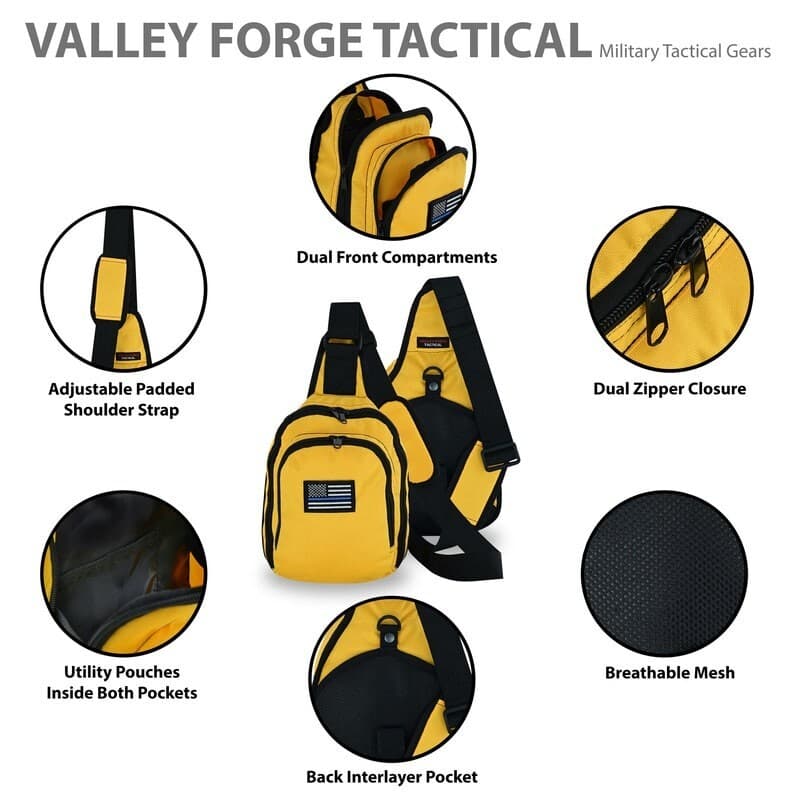
A sling bag's usable capacity has more to do with pocket layout than total volume — a bag with one big compartment forces everything into one pile, while separate zip pockets keep a phone, keys and a multitool from becoming a single tangled mass. Look at the photos, not just the spec line, before you decide.
5. New with tags vs. used
For gear that touches your body all day, condition is worth confirming explicitly. Our listings state condition plainly — the Sling Bag ships new with tags — so you're not guessing from a product photo alone.
SLING BAG
$49.90One strap, worn across the body, with an adjustable holster included.